
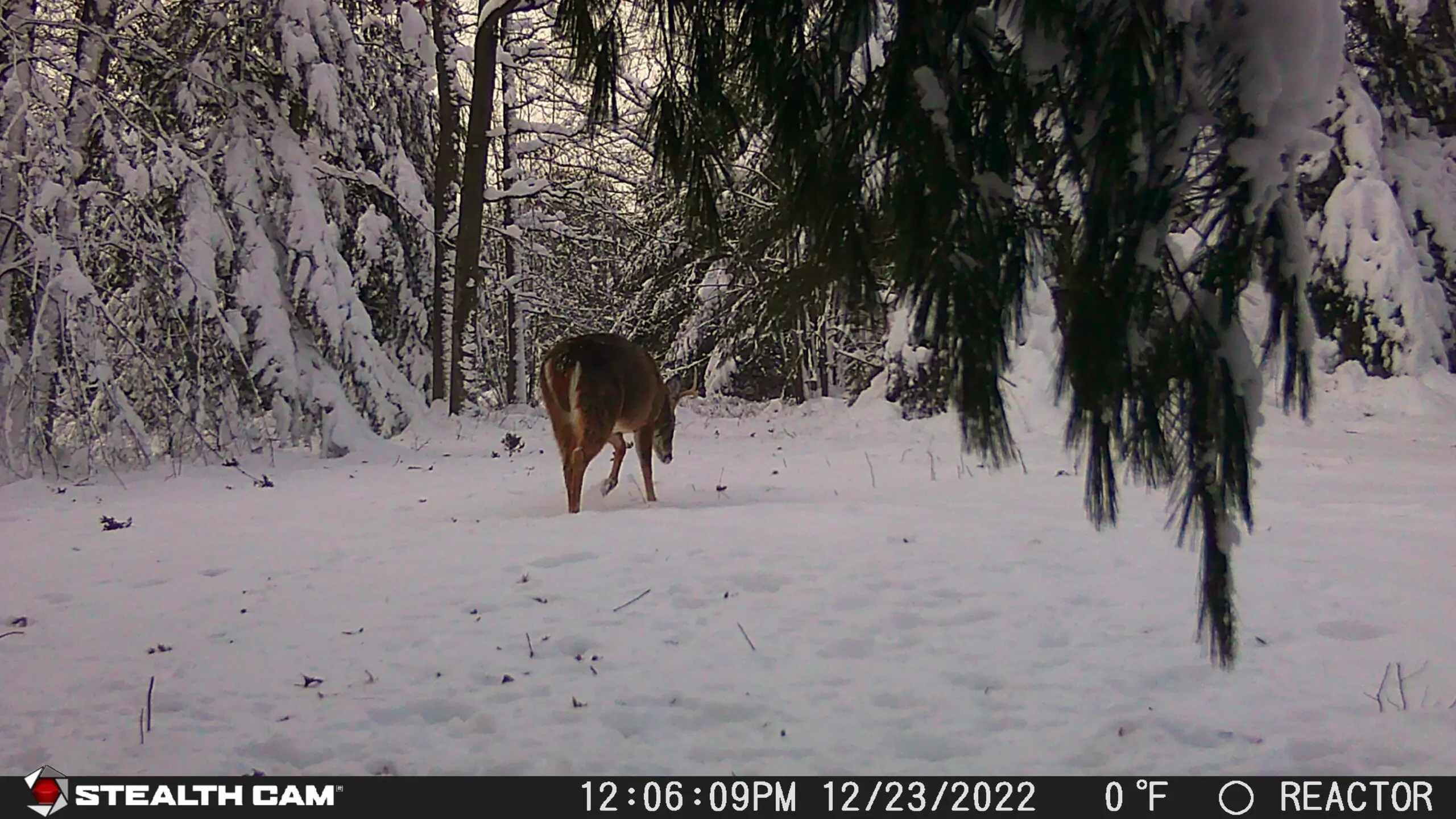
Many hunters as well as land managers only run trail cameras during the whitetail season, but a tremendous amount of data and information can be missed if those cameras are packed up and put away at the end of the season. Running trail cameras all year round can help you better manage your property, the wildlife that resides there, and prepare for success in the next season. This article will discuss the benefits you can gain from running trail cameras throughout the winter months and what useful information can be gained. It will also cover the number of cameras you might need for effective property coverage, factors to consider before deciding on this number, and advice on keeping your cameras operational during the cold winter months, including optimal placement strategies.
![Trail Camera[mp:00][tp:034f]](https://www.stealthcam.com/wp-content/uploads/2026/01/602341138_10105196622703959_1294809247246313653_n.jpg)
BENEFITS OF WINTER TRAIL CAMERA USE
Herd Health and Food Sources
Monitoring deer on your property during the winter offers many advantages. You can also use your cameras to keep an eye on food sources on your property. Typically, setting up at least one camera to watch each of your food plots, as well as areas with early successional growth where deer find woody browse, is beneficial. These areas are crucial not only for capturing great images but for observing how well deer are doing and how sustainable those crucial winter food sources are. Timely intel on these important aspects can guide you in planning what changes might be necessary in preparation for the next season.
New Bucks and the Return of Familiar Faces
Winter can be an excellent time to catch bucks that may have disappeared earlier in the season. Some bucks can vanish during early fall or the rut but return in winter, especially if your property offers high-quality winter food and bedding. Aside from seeing those familiar faces return, winter can also be a great time to catch new bucks on camera. Winter is one of two times per year that bucks are usually willing to travel substantial distances. The first is during the rut while in search of hot does, but during winter months they will travel substantial distances to find a high-quality food source and high-quality winter bedding. If your property can provide those two important resources, winter can also be an excellent time to recruit those new bucks and get them to either stay on your property or possibly return the following year.
![Trail Camera[mp:03][tp:042f]](https://www.stealthcam.com/wp-content/uploads/2026/01/593731084_10228612087519444_8422438001659893560_n.jpg)
Taking Inventory
Identifying which bucks survived the season is crucial, especially if your property doesn’t typically host many mature bucks during summer. Use the data from your trail cameras to compile a list of potential target bucks for the next season. Knowing which bucks are still around allows you to start organizing data from the previous season, noting any specific patterns and tendencies. This information is vital for making strategic adjustments to blind or stand locations, food plot plantings, and other plans to increase your odds of success. Without knowing if certain bucks are still alive, you could likely be wasting time and effort planning to hunt a buck that has already been harvested, or worse yet heading into the next season almost completely reactive, instead of having the ability to be proactive.
![Trail Camera[mp:05][tp:016f]](https://www.stealthcam.com/wp-content/uploads/2026/01/2025120820454801010172_ColorizationType.none_.jpg)
Shed Hunting
Trail cameras are invaluable for maximizing efficiency in shed hunting. While most bucks in many areas shed by the end of March, various factors can affect timing. The colder and harsher the weather, and the more stressed the bucks, the earlier they tend to shed. Using trail cameras helps you know when bucks are shedding, or when a specific buck has shed, aiding in the search for specific sheds while minimizing human pressure on the deer. One of the worst things that can happen to a deer hunter, or a shed hunter, is to push all the bucks off his or her property and have them end up on the neighbor’s property. Finding sheds is a whole lot harder when they are still attached to a buck’s head and running away from you!
Predator Management
An often-overlooked use for trail cameras during winter months is monitoring, patterning, and managing predator populations. Trail cameras can provide crucial information when it comes to gathering data such as how many, where and what impact predators may be having on your property. When it comes to controlling predator numbers, trapping is one of the most effective methods a land manager can use, and a trail camera set to take videos can uncover details of how and when predators interact with trap sets. These details can help even the most experienced trappers with becoming more efficient and effective at controlling predators! If you are managing predators on your property, consider utilizing trail cameras to help make that job easier.
![Trail Camera[mp:06][tp:018f]](https://www.stealthcam.com/wp-content/uploads/2026/01/2025121112452001010178_ColorizationType.none_.jpg)
TIPS FOR WINTER SUCCESS
How Many Cameras Do You Need?
The number of cameras that are needed to effectively cover your property throughout the winter months depends on a lot of factors. A ratio of one camera per every 5 to 20 acres is often a good baseline, allowing for comprehensive coverage. Some important things to consider while deciding on the number of cameras you need are the size of your property and the type of terrain, the amount of winter deer activity, as well as the general make-up of your property. For instance, if you have an 80-acre property with 20 acres of cover and the rest tillable, one camera per every 5 acres of cover would be recommended as a good starting point.
As you combine your boots on the ground scouting efforts with data from your trail cameras, you’ll begin to find new opportunities for placing additional trail cameras and can continue to expand your trail camera network over time.
Where to Place Your Cameras
Wintertime deer activity is focused around two main things, quality winter food, and quality winter bedding cover. Those two things might look vastly different depending where you are at within the whitetails range, but if you key in on those two resources, you will be in for a treat when it comes to getting some great wintertime pictures. Deer will oftentimes seek out bedding cover that is near a quality winter food source, so they may not travel very far between the two. If you can find some well used travel routes connecting bedding and food, especially those that are located in funnels or pinch points, they are also great locations to choose.
Don’t forget about scrapes and mock scrapes! Scraping activity slows down after the rut, but all deer, not just bucks, will continue to work scrape zones throughout the year. In winter, the licking branch becomes the focus for scent communication, so you won’t see the scraped-out area on the ground as much as you did during the late pre-rut and rut. You can further increase your chances of having a successful camera location by combining any of the previous locations. Remember, the more attractive a location is, the more opportunities your camera will have for gathering important information.
![Trail Camera[mp:01][tp:031f]](https://www.stealthcam.com/wp-content/uploads/2025/02/2025013116030301000106.jpeg)
Keeping Your Cameras Operational During Winter
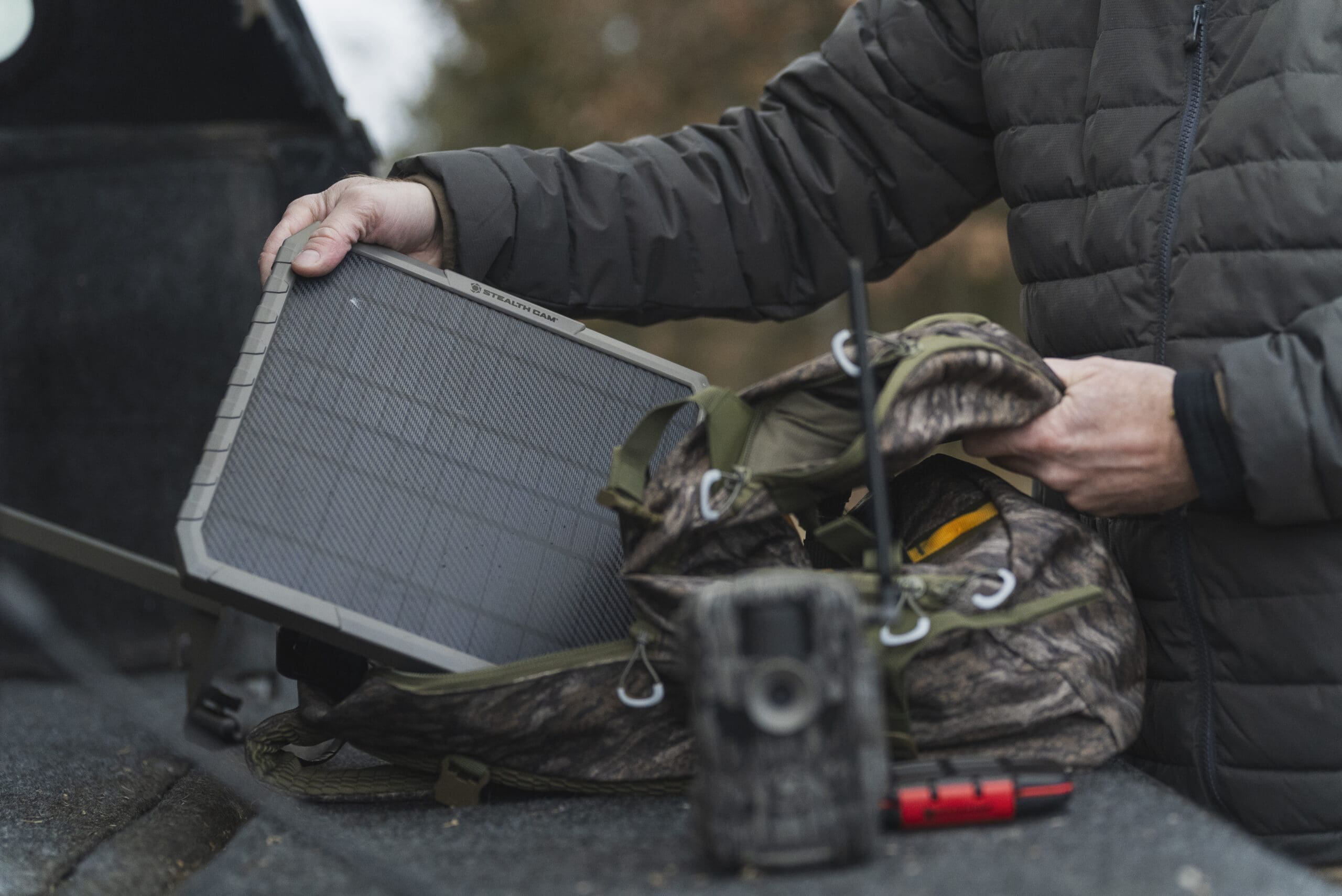
The most popular method for powering trail cameras these days is still lithium batteries, especially because they perform far better in cold weather than alkaline options. While traditional lithium AA batteries are reliable, they can become expensive over time. That’s where our Stealth Cam internal lithium battery packs come in. Available for all Revolver 360-series cameras, MAX cameras, and the Flashback, these rechargeable packs offer a low-cost, easy way to keep cameras powered. We recommend keeping a spare or two fully charged for quick battery changes in the field—just swap the pack and you’re back up and running in under 10 seconds.
A solar battery pack is another excellent year-round solution, especially this time of year when foliage isn’t a concern. With ample sunlight, solar setups can keep cameras powered continuously and eliminate frequent battery changes. While solar battery packs may seem expensive upfront, they quickly pay for themselves and don’t require constant replacement like AA batteries. The Stealth Cam 3,000mAh SOL-PAK costs roughly the same as just three sets of eight name-brand lithium AA batteries, making it a smart long-term investment for trail camera power.
Click to browse all solar and battery pack options.
FINAL THOUGHTS
Trail cameras are a versatile tool beneficial year-round, aiding hunters and land managers in gathering information that is crucial for successful wildlife management and hunting preparation. If you haven’t tried running your trail cameras throughout the winter months, consider the benefits and insights you might be missing.
Looking to expand your cellular trail camera network? Take advantage of special winter savings on the Revolver Pro 360º. Now priced at $99.99 each, down from $149.99. Click here to check out all the winter deals on your favorite cellular trail cameras.